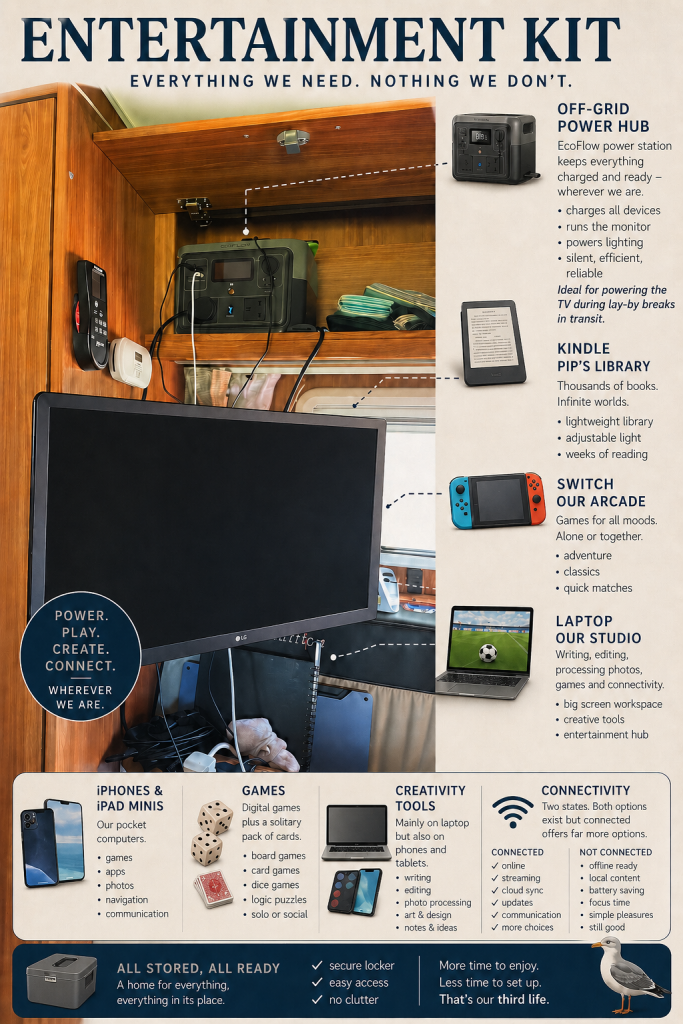

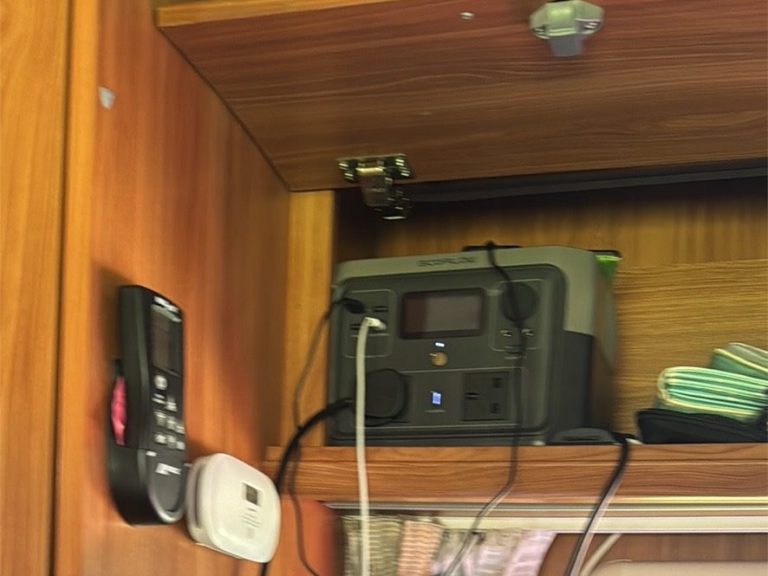
The smallest room in our motorhome is a cupboard.
Open the door and you’ll find a Wi-Fi router, a cluster of chargers and a handful of devices stacked neatly on a shelf — tablets, phones, a laptop, a Kindle, and a Nintendo Switch. It looks like the sort of cupboard most houses acquire somewhere along the way: the place where cables mysteriously multiply overnight. In our van it has acquired a rather grander job. Inside that locker sits a library, cinema, music system, newspaper stand, games room and creative studio.
Not very long ago the same collection of leisure would have filled a significant part of the van: shelves of books, stacks of magazines, boxes of board games, CDs, cameras, photo albums and puzzles. Today most of that cultural life has quietly dematerialised. It exists as data. For travellers living in 7.4 metres, that shift matters.
Space, weight, and power are the governing laws of life in a motorhome. Every object must justify its place. The cupboard that holds our devices has quietly become the games room, library and studio of the van — a miniature leisure infrastructure occupying little more space than a bread bin.
Two worlds: connected and offline
Modern digital leisure usually assumes connectivity. Films stream, newspapers refresh constantly and games update themselves overnight. At home we rarely notice how dependent our leisure has become on the quiet presence of the internet.
Van life reminds you quickly that connectivity is not guaranteed. Site WIFI varies greatly. A good router and local SIM card can provide excellent coverage much of the time, but mountains, borders, remote campsites and temperamental networks occasionally pull the plug. Some evenings the router lights glow reassuringly and the outside world flows into the van without interruption. On others the signal fades behind the landscape and the van quietly reverts to its offline life.
That is when the cupboard earns its keep in a different way.
Many of the things inside it work perfectly well without a signal. A Kindle still contains a library. Games already installed on the Switch still play. A laptop still runs editing software, photographs, puzzles, and music. Even a digital jigsaw made from one of my own photographs can occupy a quiet hour without needing a single bar of reception.
Connectivity expands the system. But the cupboard still functions when it disappears.
The Third Constraint: Power
There is one more quiet limit. Energy. Battery technology has improved enormously in recent years. Phones, tablets and laptops now run for many hours between charges, and modern vans with lithium batteries, solar panels and efficient power systems make recharging relatively straightforward.
But the system is still finite. Eventually everything needs to be plugged back in. That reality shapes the cupboard just as much as space does. Devices that draw modest power and perform several roles earn their place quickly.
A tablet becomes a television screen. A phone becomes a camera, music player and navigation tool.
A laptop becomes a writing desk, editing suite and puzzle table. The locker becomes less about storage and more about capability.
The dematerialised games room
What sits inside that small cupboard is more than a collection of gadgets. It represents something that has quietly changed in the last twenty years: leisure has become portable in a way it never was before. Books became files. Board games became software. Music collections shrank to pocket size. Photographs moved from albums to digital archives.
For people living in fixed houses the change is convenient. For people living in moving ones it is transformative. Within the confines of a tiny cupboard, digitisation and connectivity together provide a cultural life that once required shelves, boxes, and weight. A moving home can now carry a library, cinema, studio, and games room without sacrificing space needed for more practical things.
The smallest room in our van turns out to be one of the most capable.