
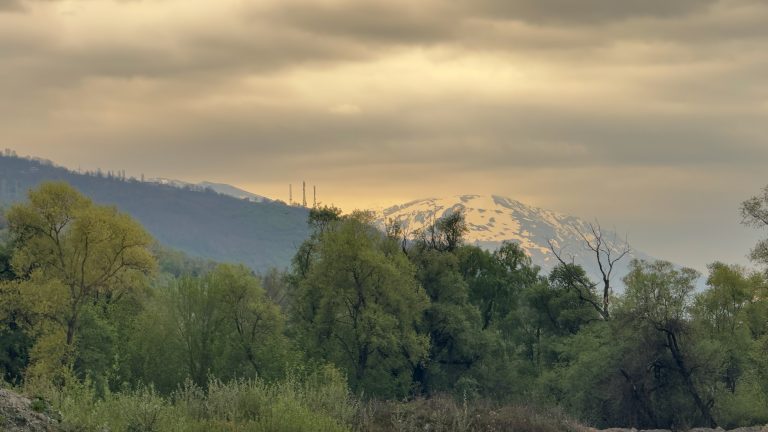
At first glance this is simply a mountain photograph. Snow on top. Green below. Slightly dramatic sky. Pleasant enough. Scroll on. That is usually where most of us stop looking.
This photograph was taken at 0700 on 21 April during Scylla’s morning walk, from the rather less glamorous side of Lake Ohrid — a patch of rough ground opposite our campsite that doubles as dog walking route, unofficial bird hide, and what appears to be an active municipal spoil tip. Romance, as ever, is in the eye of the beholder.
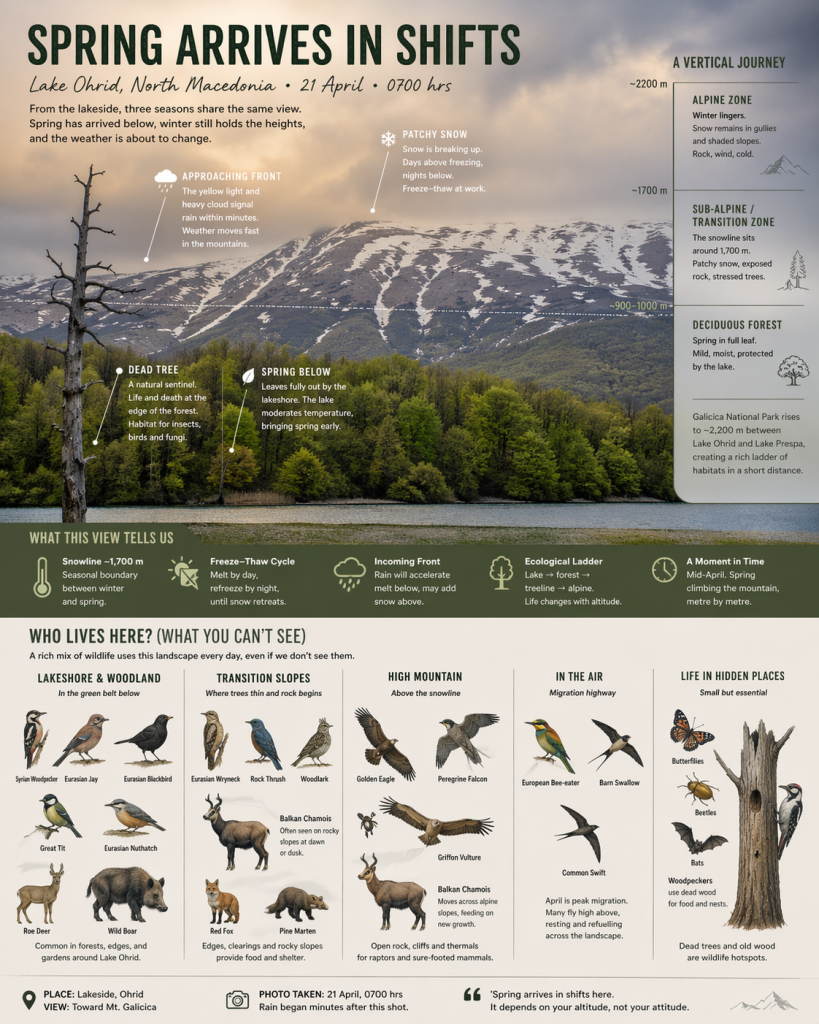
Across the lake sits Galičica National Park, climbing to roughly 2,200 metres between Lake Ohrid and Lake Prespa. What makes this image interesting is that it captures several seasons occupying the same frame at once.
At lake level, spring has fully arrived. Trees are in leaf. Insects are active. Birds are breeding or passing through on migration. The reed beds are waking up. Halfway up the mountain, spring is still negotiating terms.
At around 1,700 metres, winter remains stubbornly lodged in gullies and shaded slopes. That snowline tells us quite a lot. The broken pattern matters. This is not fresh snowfall. The snowpack is retreating. Daytime temperatures are now warm enough to expose darker rock, while night temperatures remain cold enough for refreezing. It is seasonal withdrawal rather than dramatic weather event — winter leaving reluctantly, metre by metre.
Then there is the sky. That yellow-grey light lasted only a matter of minutes before rain arrived over our campsite. Mountain weather often telegraphs its intentions if you pay attention. Thickening cloud over the ridge line, flattening contrast and that strange, bruised light all suggested incoming rain. Twenty minutes later we were back inside the motorhome listening to it drum against the roof. The mountain had issued fair warning.
Then there is my favourite witness in the photograph.
The dead tree. To most people it looks like decay. To wildlife it is prime real estate. Dead standing timber supports fungi, beetles, and other insects. Woodpeckers excavate nesting cavities. Those cavities are later reused by smaller birds, bats, and anything else seeking secure shelter. It is less a dead tree than an apartment block with excellent ecological credentials. And it fits what we’ve observed here.
I’ve watched a Eurasian Wryneck twisting improbably on a branch as though evolution changed its mind halfway through assembly. I’ve seen Eurasian Hoopoe probing the ground, looking as if they were designed with complete creative freedom and no committee oversight whatsoever. Great Spotted Woodpecker, Lesser Spotted Woodpecker and European Green Woodpecker have all turned up in this wider patchwork of woodland and scrub.
That alone tells you this ecosystem is healthier than the spoil heap setting initially suggests.
The small reed bed near the dumping ground looks insignificant until you spend time there. Common Moorhen move quietly through the margins. Great Cormorant patrol nearby waters. And then there is the noise. Great Reed Warbler produce a frankly ridiculous amount of sound for such a small bird. Hidden deep in cover, they shout with the confidence of creatures entirely unaware of their own dimensions. Somewhere deeper in the reeds, Little Bittern bark like tiny, irritated dogs while remaining almost entirely invisible.
Overhead, swallows pass low over the lake. Higher still, migration continues beyond the range of casual human attention.
And then there is what we cannot see.
Those forests almost certainly hold mammals that have shown me the courtesy of remaining unseen. Higher slopes are suitable habitat for Balkan Chamois. Raptors will be working thermals above the ridges. Entire lives are unfolding beyond the narrow slice of reality captured by a camera sensor.
That may be the real lesson in all this. A landscape is rarely static scenery. It is weather, altitude, migration, decay, adaptation, and timing — all operating at once whether we notice or not.
When we first arrived in Ohrid, this was simply the mountain view. Now I can read it. Not perfectly. Not romantically. Just with slightly more literacy than I had before. And that, I suspect, is one of the quiet rewards of staying somewhere long enough.
A morning dog walk becomes fieldwork. A spoil tip becomes habitat. A photograph becomes evidence that the world is far busier, stranger and more intricate than it first appears.
Not bad for 7am.