

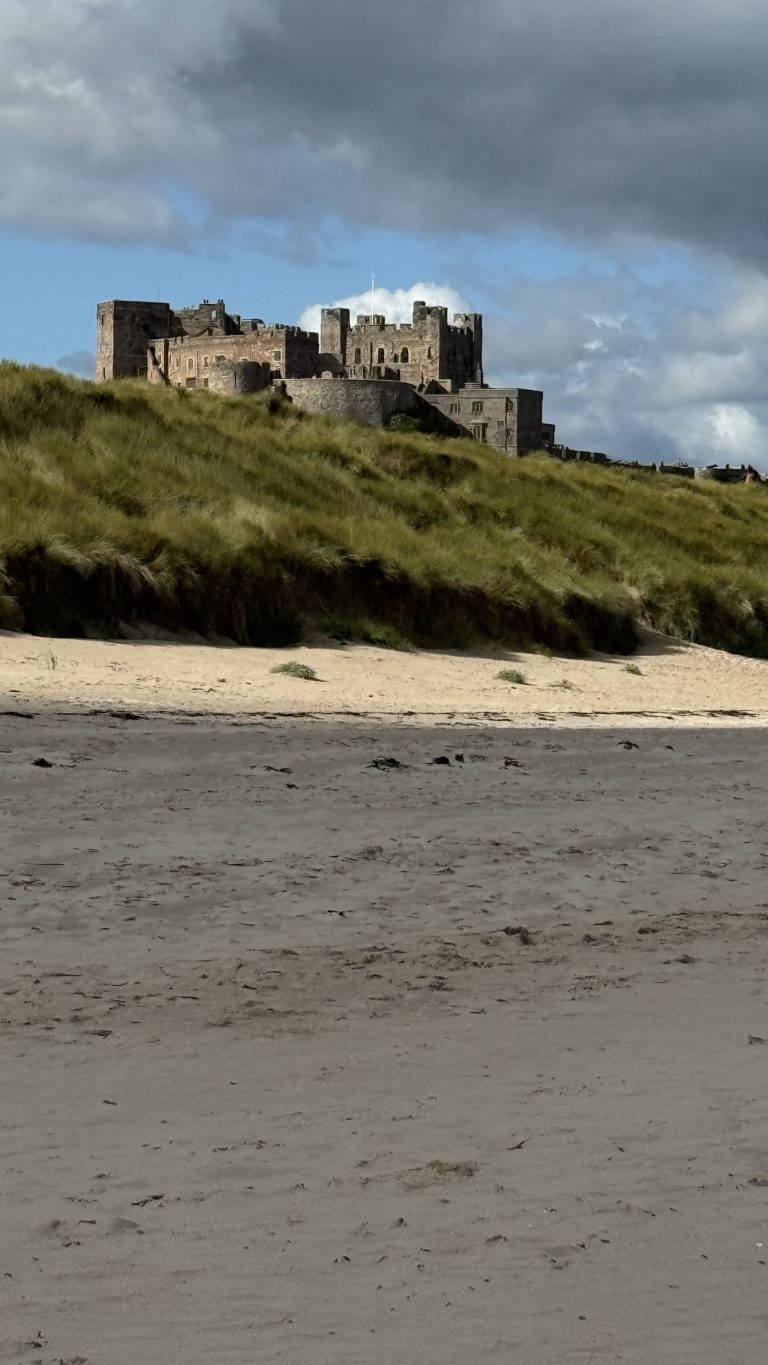
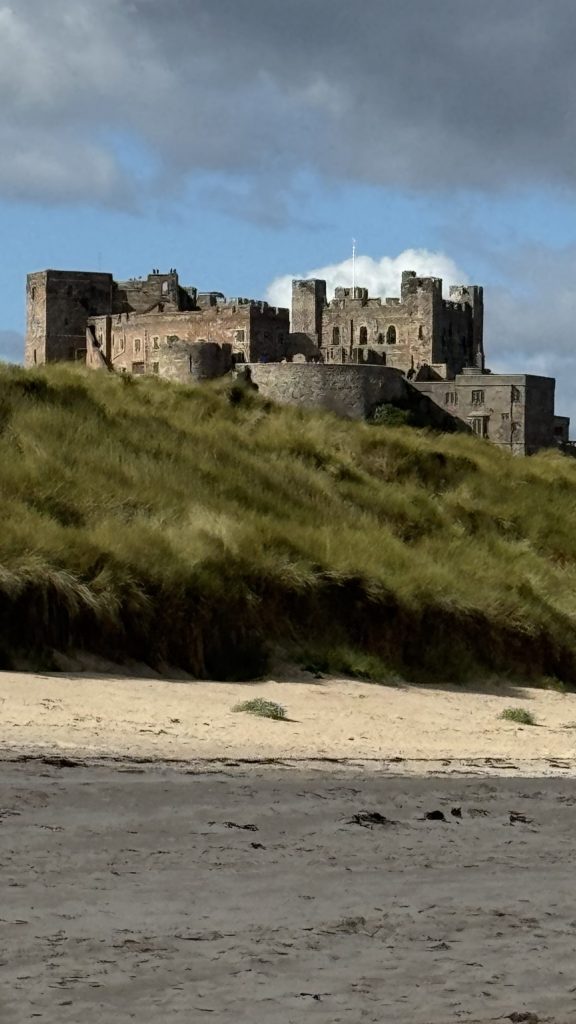
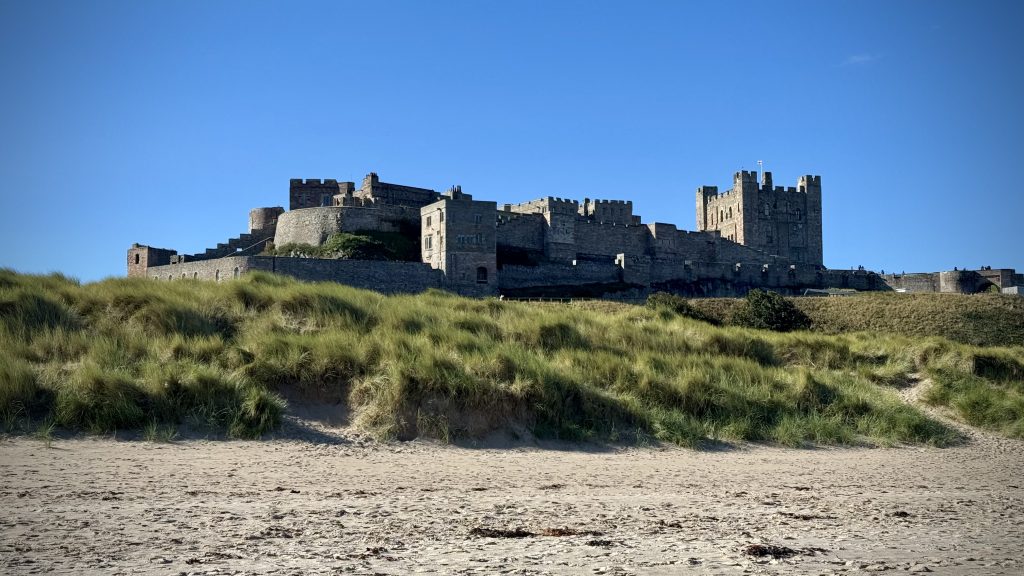
Driving down the coast road, the first glimpse of Bamburgh is enough to stop conversation. The castle doesn’t perch delicately on its headland; it dominates, a sheer face of stone rising straight from the rock and the restless North Sea. It has that rare quality of looking both eternal and alive, as if the centuries haven’t silenced it but only given it more to say. We parked up and walked down to the sands, Scylla eager to stretch her legs. The tide was on the turn, the surf rushing in with a rhythm older than any kingdom. Bamburgh loomed above, as it has done for one and a half thousand years.
But here’s the truth: what you see now is only one layer in the story. Long before the Norman stone, there was Din Guarie, a Celtic stronghold clinging to this same outcrop. Then came the Anglo-Saxons, and Bamburgh became the royal seat of Bernicia. Imagine the timber halls, the firelight, the smell of smoke and salted meat, the sound of kings plotting alliances and wars. This was where Northumbria took shape, a kingdom stretching from coast to coast. One king, Oswald, is remembered not just for his sword but his faith. He fought under the sign of the cross, and when he ruled from Bamburgh, he brought St Aidan from Iona to spread Christianity across the north. The saint came often to this castle, and stories say he performed miracles here. Some visitors come for the battlements; others come because this was once a centre of spiritual fire.
But Bamburgh’s tale is no smooth ascent. Vikings stormed and burned it in 993. The Normans rebuilt it in stone, turning it into the fortress that still grips the skyline. For centuries it was a border stronghold, guarding against the Scots. And in 1464, during the Wars of the Roses, Bamburgh was the first castle in England to be destroyed by cannon fire. Gunpowder ended the age of castles, and Bamburgh bore the scars. Centuries later, it rose once more. William Armstrong, the Victorian industrialist, bought the ruin and poured money into rebuilding it. Armstrong was a man of science and philanthropy; he restored Bamburgh as both home and institution, adding a school and hospital within its walls. A fortress of kings became, improbably, a place of learning and healing.
And yet, for all this history, you can’t stand here without the myths creeping in.
The Laidly Worm of Spindleston Heugh, for instance — a princess cursed by her jealous stepmother, transformed into a dragon that terrorised the land. She coiled around the hills near Bamburgh until her brother returned and kissed her, breaking the spell. No historian would write her into the record, but somehow, she feels at home in this place of shifting power and peril.
Others speak of ghost ships, pale sails glimpsed in stormlight from these battlements, omens of death and disaster. Or of Arthurian knights — some medieval writers even claimed Sir Lancelot was buried here. And then there’s Oswald again, whose severed head was said to rest here as a holy relic before being carried to Durham. Was it politics, piety, or just story-making? Likely all three.
These are not contradictions but layers. Bamburgh wears them all at once: fortress of kings, shrine of saints, ruin of war, dragon’s lair, Victorian vision.
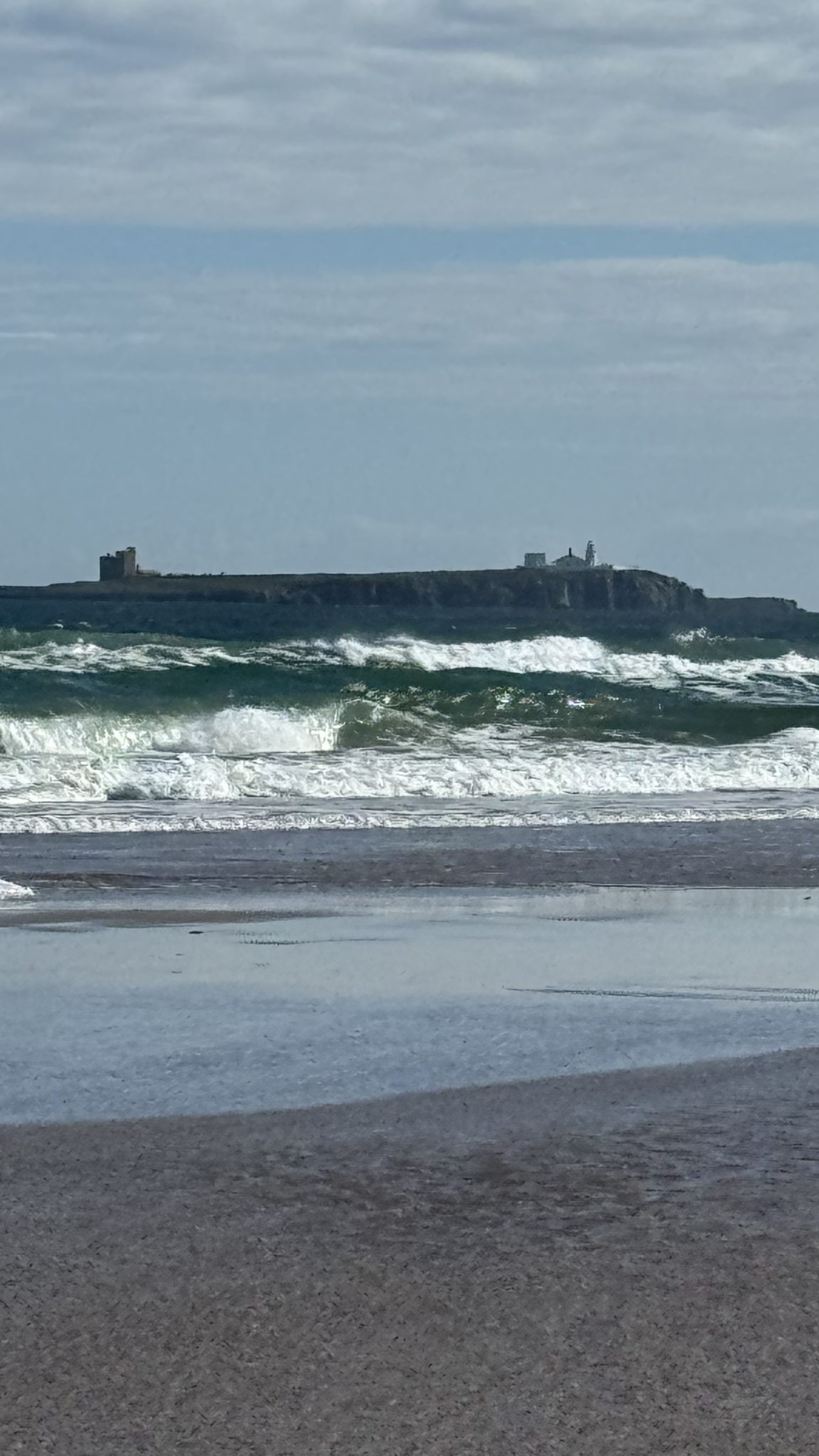
As we stood on the sands with the wind pushing hard and Scylla bounding after driftwood, II felt those layers shift and stir. The same sea Oswald must have looked out upon, the same winds that lashed Norman sails, the same sands where villagers whispered about dragons.
The children playing nearby, building sandcastles only to watch the tide take them, seemed part of it too — their laughter another voice in Bamburgh’s long chorus. That’s what I take from places like this: not a fixed story, but a continuum. We walk into their line of time, pause for an hour or a day, and walk out again. The castle remains, heavy with all that has passed, open to whatever comes next. And perhaps that’s why it grips me more than any neat heritage plaque or guided tour — because it reminds me that the past isn’t sealed off. It is still here, in stone and sand and story, waiting for us to listen.