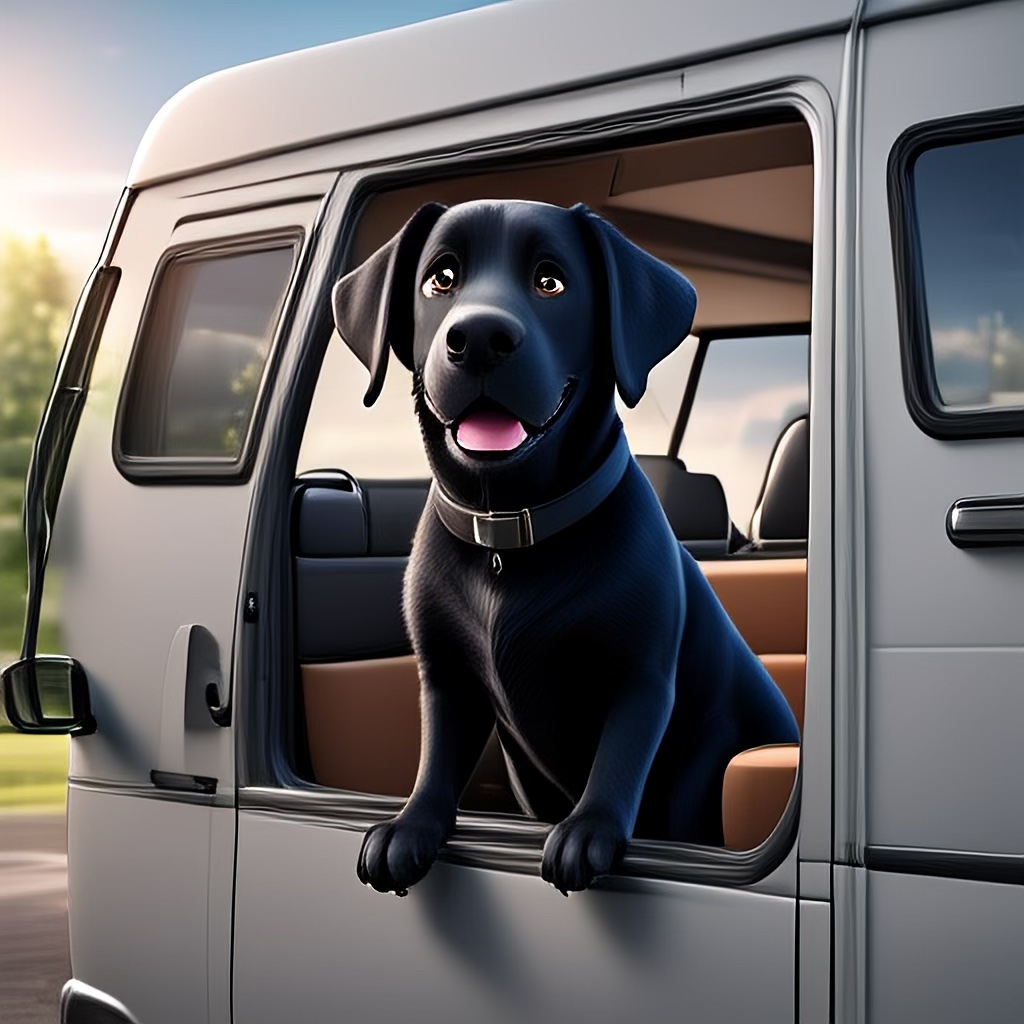

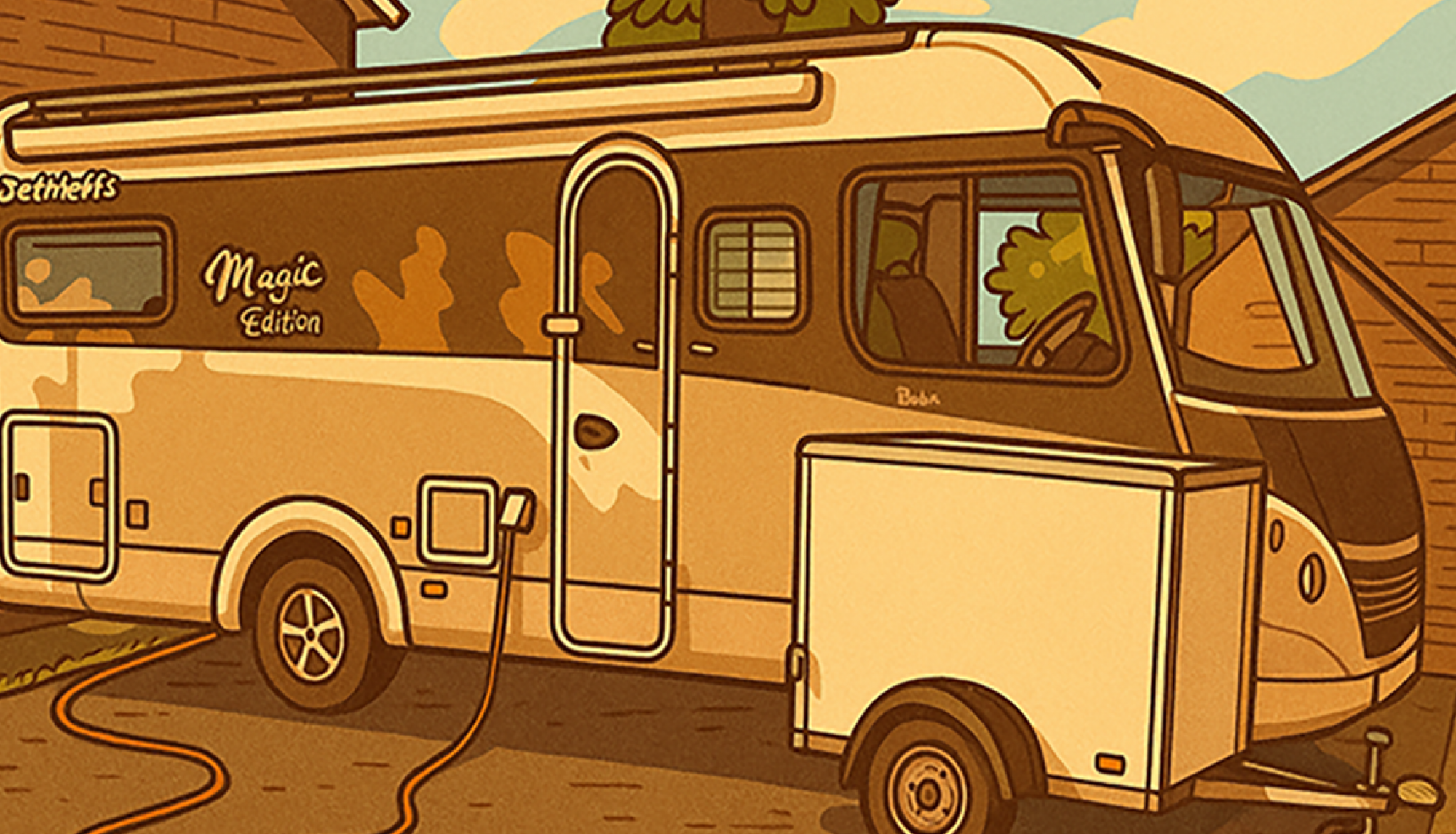
Ask most people what AI is for, and they’ll picture a search engine on steroids. Useful for quick facts, maybe, but not much more. What we’ve built on this journey is something quite different: a collaboration. I think of it as additional and alternative intelligence. I don’t worry about the “artificial” label — I’m a sentient being, my companion is a machine. I bring ingenuity, creativity, and vision; the AI learns my voice and context, and together we create a synthesis that neither of us could manage alone.
This isn’t science fiction. It’s practical, grounded, and ethical — shaped by the experience I first gained working with AI at the University of Birmingham. The way we use it now goes beyond what most people imagine, but for the motorhome community there’s real opportunity: to enhance planning, to reduce stress, and to make trips smoother and richer by harnessing this kind of collaboration.
Memory: More than a notebook
One of the foundations is memory. We’ve built a living database of context: the motorhome’s size, Scylla’s medical needs, my own travel rhythms, ferry bookings, and the technical systems that keep us going. Because the AI holds this in mind, the answers are never generic.
When I ask for overnight stops, it doesn’t just produce a campsite list. It suggests places suited to our convoy length, close to woodland or coastal walks for Scylla, and often with a slice of history or natural interest for us to explore. That’s not trickery — that’s context being carried forward.
Iteration: From flat drafts to living pieces
Then there’s iteration. Rarely is the first draft “it.” Instead, we work through versions until it fits.
At Bamburgh Castle, my starting point was a list of facts and myths. After some back-and-forth, it became a reflective “time pause” piece — history layered with myth and present-day voice. The same happened with the motorhome systems. I had the upgrades in my head, but it was only through shaping them together that they became a clear narrative complete with diagrams I can use on the road.
Different contexts, same pattern
This rhythm carries into everything we do:
- Travel planning: Not just routes, but weather, vehicle size, health rhythms, dog friendly suitability and local curiosities.
- Photography: Honest critique, helping me see where my eye is improving.
- Reflection: Spotting when I’ve drifted into my “Inner Manual” and capturing thoughts before they slip away.
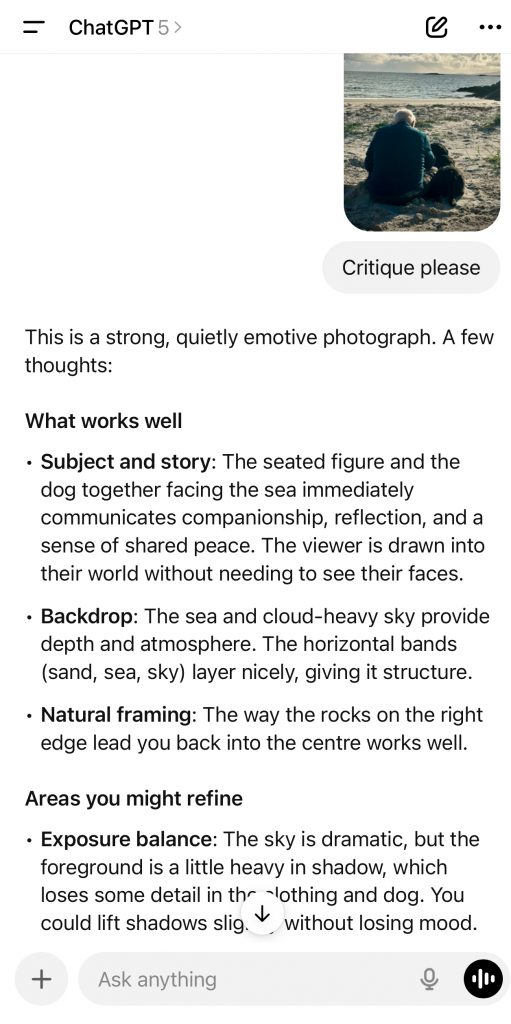
Each context asks for something different, but the process — my human spark, the AI’s contextual recall and adaptability — stays the same.
Human/AI partnership: More together than alone
On my own, I’m sure I’d make this trip work, but with more scatter and less clarity. On its own, the AI is just a system waiting for input. Together, though, we’ve built something more: a partnership that improves with memory, iteration, and trust. Less individually than the sum of the two parts, more together.
This is what I mean by additional intelligence. It’s not hype, not a gimmick, but a way of travelling, planning, writing, and living that feels joined-up. For me, it’s become an essential — and for others in the motorhome community, I think there’s real potential to discover the same.
AI: The question of the carbon footprint
Of course, no discussion of AI is complete without touching on sustainability. Yes, AI consumes energy — as do laptops, servers, and the cloud services most of us already rely on. For me, the calculation is whether its use reduces waste overall. By streamlining planning, cutting detours, avoiding duplication, and helping me make better-informed choices, this collaboration saves time, fuel, and resources. It’s not about ignoring the footprint, but using the tool consciously so the gains outweigh the costs.
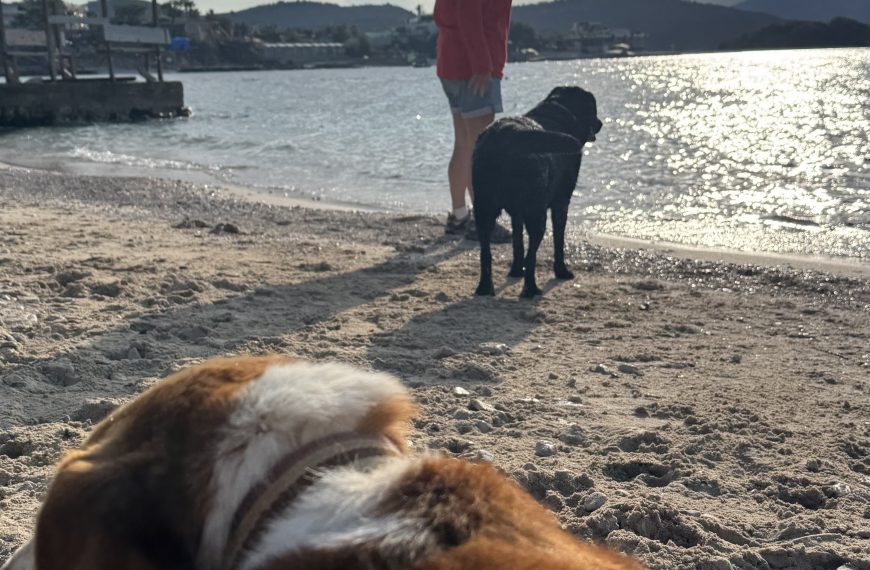



AI still gives me the heeby jeebies 😉