

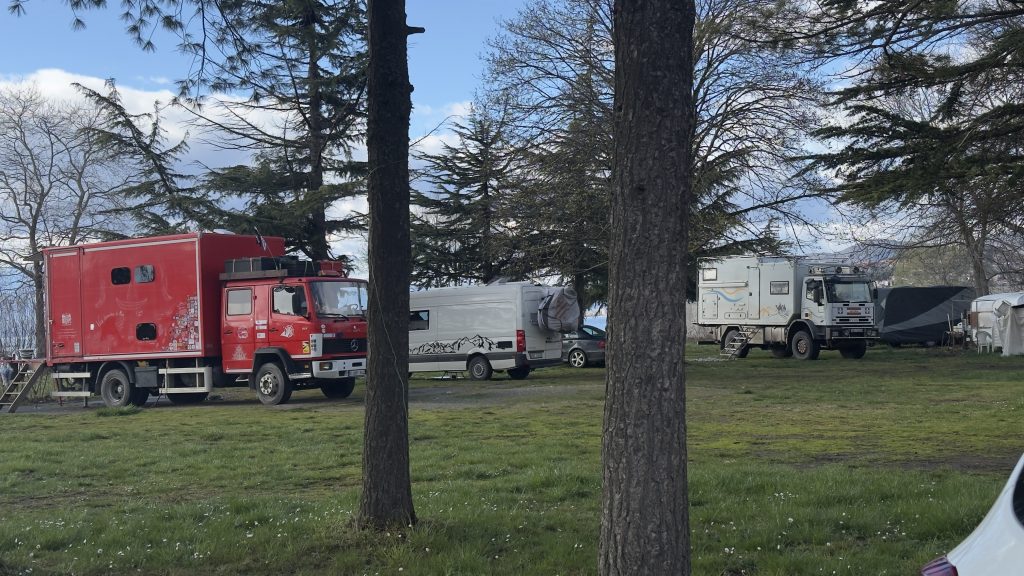
Temporary villages form in curious ways. Nobody plans them. No one appoints a mayor or draws a street map. Yet give people a place to stop for long enough and patterns appear that look remarkably like a settlement.
Our time in Ohrid offered a good example. During Orthodox Easter, the character of the site changed almost overnight. The mix of travellers shifted. Bulgarians, Romanians and Greeks arrived in larger numbers, many visiting the city for its religious significance. The monasteries and churches that shape Ohrid’s long spiritual history still draw people here today, just as they have for centuries.
For a while the campsite felt less like a row of vehicles and more like a small, temporary village.
Language clues
Language is one of the first things you notice. Conversations drift across the site in many accents and rhythms. Even when we cannot understand the words, the patterns soon become familiar. Bulgarian sounds different to Romanian. Greek different again.
Before long we started listening for these cues. When a new vehicle arrived, we glanced at the number plate and tried a greeting in the likely language — a quick dobro utro, guten morgen or bună dimineața. Our pronunciation accuracy differed, but people usually appreciated the effort. In places like this, language becomes a small but useful form of social currency.
Visual clues
Number plates supply another source of amateur data. During our stay we developed a habit of quietly noting where vehicles seemed to come from. It felt like field research, although the results were rarely pure.
One UK-registered motorhome stayed for a week. The obvious assumption is English. The occupants were a married couple — Bulgarian and Irish — travelling together and, as it happens, readers of this magazine. A German plate nearby belonged to an Australian family of five exploring the Balkans. A Hungarian-registered van we assumed was Hungarian turned out to be driven by a Dutch couple.
Number plates reveal where a vehicle was registered. They do not necessarily reveal who lives inside.
Identity clues
Sometimes travellers add a second layer of information. Many decorate their vehicles with small signals of identity. Another UK-plated van here carried a large red dragon on the rear panel, leaving little doubt that its occupants were not English, but Welsh. Some travellers raise portable flagpoles beside their vans to display their national flag. Others use flags or stickers to signal political solidarity or protest. A Palestinian flag flying beside one vehicle was a quiet example of that.
Motorhomes often become travelling noticeboards. Before a word is spoken you can read fragments of a story: nationality, values, family structure, even hints of the journey already taken. Rainbow stickers quietly signal LGBTQ+ identity. Some vehicles display rows of flags marking countries visited. Others show the familiar cartoon stick figures that reveal the family living inside.
Even the way vehicles park reveals patterns. Campsites in the Balkans rarely mark out pitches clearly, but most travellers develop an instinctive sense of distance – an invisible boundary between one van and the next. And, people’s needs differ, some people cluster closely together, recreating the feel of a village street. Others spread out and claim a little territory around their van. The result is a landscape of informal neighbourhoods — clusters and gaps that appear without anyone planning them.
Most people, however, try to leave a little breathing room. Occasionally someone interprets that boundary differently. As I was drafting this article, a German-plated van squeezed into a narrow gap beside us. Perfectly possible, entirely legal here – but noticeably closer than the unwritten norm and less easy to understand when the site was nowhere near full. It is a small reminder that every village, however temporary, runs on shared expectations, and that those expectations are interpreted slightly differently by everyone who arrives.
A place to trade information
The campsite also becomes a small trading hub. Travellers swap information constantly. Where did you stay in Montenegro? Which border crossing worked best? Is there a good place to service the van further south? What equipment are you carrying, and does it work?
Advice moves easily from one vehicle to another, much as travellers once exchanged news at ports, caravanserai or market towns.
The result
Give travellers enough time in one place and a small settlement forms. Languages mix. Information flows. Identities appear through flags, stickers and conversation. Space gets negotiated quietly and informally. In other words, a campsite becomes a village. For a fleeting time at least.