

January was a month where the systems had to work quietly in the background. No heroics, no failures worth retelling — just sustained use across countries, climates, and operating conditions. That’s often the truest test.
This isn’t a catalogue of clever solutions or upgrades. It’s a review of what proved itself through repetition and mild stress, and what earned its place by simply not becoming a problem.
Navigation: Top of the stack
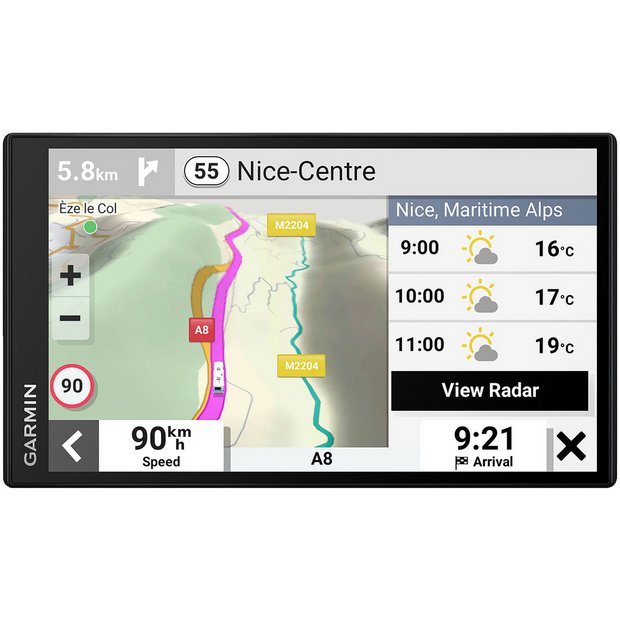
Satellite navigation remains one of the most important system we run.
That might sound obvious, but its value compounds when you’re travelling at scale and across jurisdictions. It isn’t just about getting from A to B. It’s about managing vehicle size, road suitability, gradients, low bridges, weight limits, urban restrictions, and timing — all while reducing cognitive load.
Good navigation removes a whole category of decision-making before it ever reaches you. It narrows uncertainty early, which matters far more than elegance or speed. When it’s working well, you arrive calmer, with more capacity left for everything else the day requires.
January reinforced that. No memorable wrong turns. No last-minute reversals. Just quiet confidence that the route made sense.
That isn’t convenience. It’s resilience.
Connectivity: boring, reliable, and everywhere it needed to be
Connectivity has continued to perform exactly as hoped — which is the highest compliment you can give a system like this.
In Italy, unlimited data at a reasonable price meant we simply stopped thinking about usage. No rationing. No workarounds. No low-grade anxiety about streaming, uploading, or navigation updates. It faded into the background, which is precisely where it belongs.
In Greece, the Orange Holiday SIM did exactly what it said it would. We were only there for a few days, but it held signal and reliability throughout. More interestingly, it has continued to work seamlessly in southern Albania — we’re currently only around ten kilometres from the Greek mainland, and the handover has been invisible.
That continuity matters. It keeps daily life — writing, planning, communication — feeling joined up rather than fragmented by geography.
Connectivity this month didn’t feel clever.
It felt dependable.
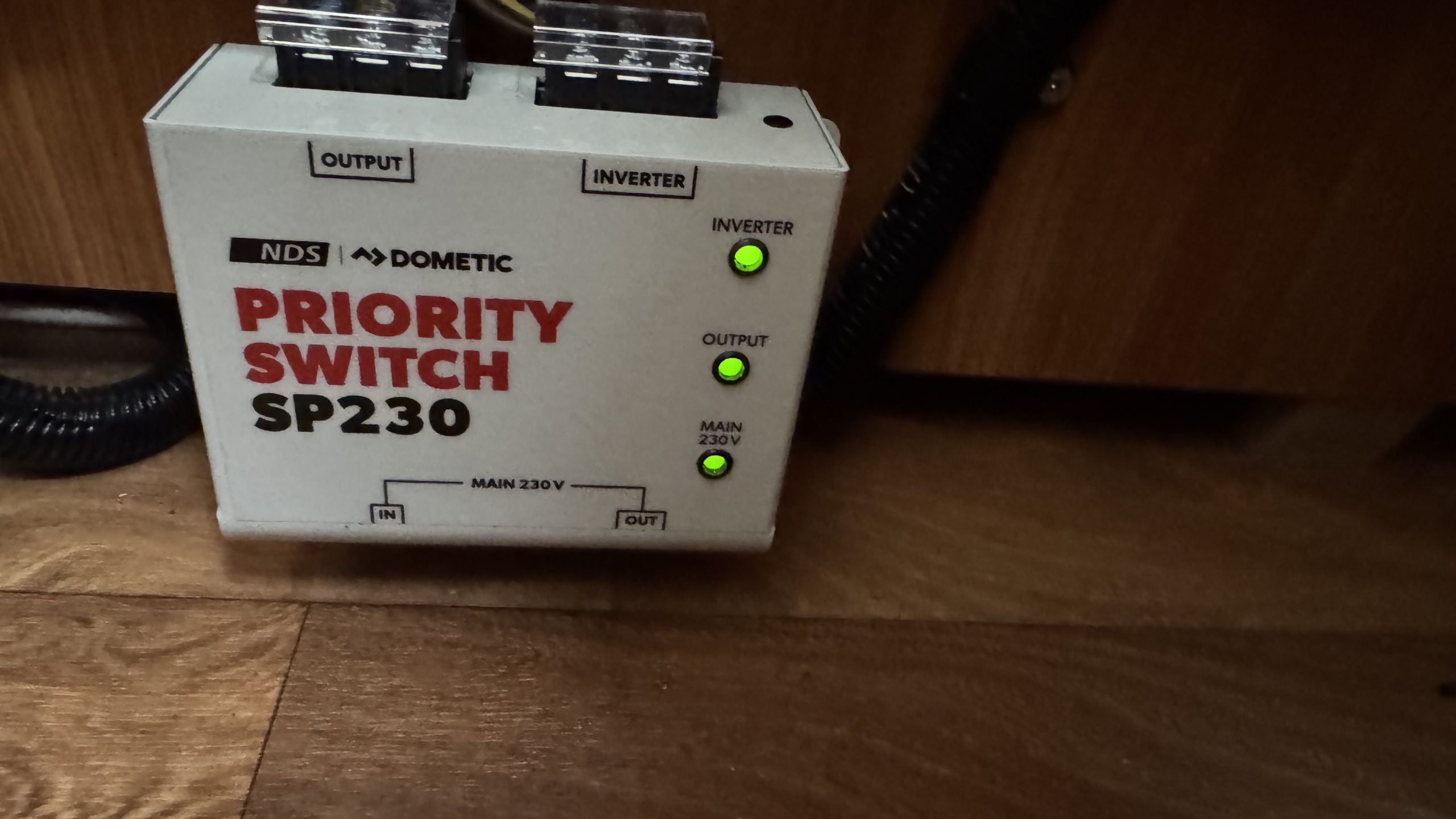
Gas and electricity: clarity brings calm
Energy systems have been a quiet success.
More than the hardware itself, what’s changed is clarity: a clear understanding of what each energy source is for, and when it makes sense to use it. That understanding removes guesswork and turns energy management into a series of calm, deliberate choices.
Electric when it’s abundant and stable.
Gas when it’s efficient and appropriate.
Solar when it makes sense to harvest it, not chase it.
What’s worked well is using the best fuel available at the time, rather than defaulting to one source out of habit. On sites with reliable hook-up, we’ve leaned into electric for heating and charging, preserving gas for transit days and unknown stops. Off-grid or on weaker supplies, gas steps back into its natural role: reliable, predictable, independent.
Two small but telling examples:
- Running heating on electric when site supply allows — not because it’s “better”, but because it protects gas for flexibility later.
- Being deliberate about when to draw from stored power versus letting the system idle and recover, rather than constantly topping up “just in case”.
Nothing dramatic. Just systems doing what they’re meant to do, without fuss.
January was notable for how little attention energy demanded — which is exactly the point.
The Usual Suspects (plus a few quiet upgrades)
Most of the core kit continues to justify itself simply by not becoming an issue. Familiar tools, familiar routines, no surprises.
A few additions stood out.
Stick blender: a small upgrade with real effect
The stick blender made its debut this month, and it’s earned its place.
It’s not essential. But it adds a level of sophistication that’s disproportionate to its size and power draw. It turns basic ingredients into something more considered — sauces, soups, blended vegetables — without introducing mess or storage headaches.
In a small kitchen, that matters.
It’s the difference between making do and cooking properly. Not restaurant food, not performance cooking — just meals that feel finished rather than assembled.
Scylla’s brain toys: containment without compromise

Scylla’s brain toys have been invaluable on travel-heavy days. Used properly, they’re not a substitute for exercise — nothing replaces movement, sniffing, and time outside — but they’re an excellent addition when confinement is unavoidable.
They provide engagement without over-stimulation, something to focus on while parked or waiting, and a way to keep her mentally settled when physical outlets are temporarily limited.
Like most things that work well, they’re effective because they’re used deliberately, not relied upon.
Knife sharpener: sharp tools reduce friction
We’re only carrying three knives, and they get a rigorous daily workout. That makes edge maintenance non-negotiable.
The Any Sharp knife sharpener is the first genuinely effective sharpener we’ve used — simple, compact, and consistent. No technique to relearn, no fiddling, just a sharp edge when it’s needed.
This might sound trivial, but sharp tools change how cooking feels. They reduce effort, improve control, and remove a surprising amount of low-level irritation. Again, in a small kitchen, that matters.
Apps: quiet helpers
Not all useful systems look like systems.
One of the most unexpectedly helpful tools this month has been the iPhone calculator app, set to currency mode. It allows quick, real-time mental accounting across currencies without opening separate apps or second-guessing exchange rates.
It’s not about penny-pinching. It’s about keeping prices legible, decisions grounded, and comparisons honest — especially when you’re moving between countries and currencies in quick succession.
Simple. Immediate. Always to hand.
What January confirmed
January wasn’t about stress-testing systems to destruction. It was about confirming that the fundamentals are sound.
- Navigation reduced cognitive load
- Connectivity preserved continuity
- Energy systems were understood, not juggled
- Kit earned its keep by staying unremarkable
That combination creates something subtle but valuable: mental space.
When the systems hold, attention can go elsewhere — to writing, cooking, walking, noticing. That’s the real dividend.
Nothing here is optimised to the last decimal point, and that’s deliberate. These systems are good enough, resilient enough, and understood well enough to support the life we’re actually living — not an idealised version of it.
January didn’t ask for brilliance.
It asked for reliability.
And this month, the systems answered.




This is such a thorough and enjoyable read! and your dog is an icon