
Motorhomes aren’t delicate flowers, but they’re not indestructible either. A few weeks into life on the road, ours met its first proper test: a sudden electrical spike at an aire. No sparks, no drama, just the quiet click of something giving up the ghost.
A small reminder that, lovely as Europe’s aires are, the power supply can be… let’s call it “aspirational.”
This is what actually happened, and what it taught us .
1. Aire electrics: Generous but temperamental
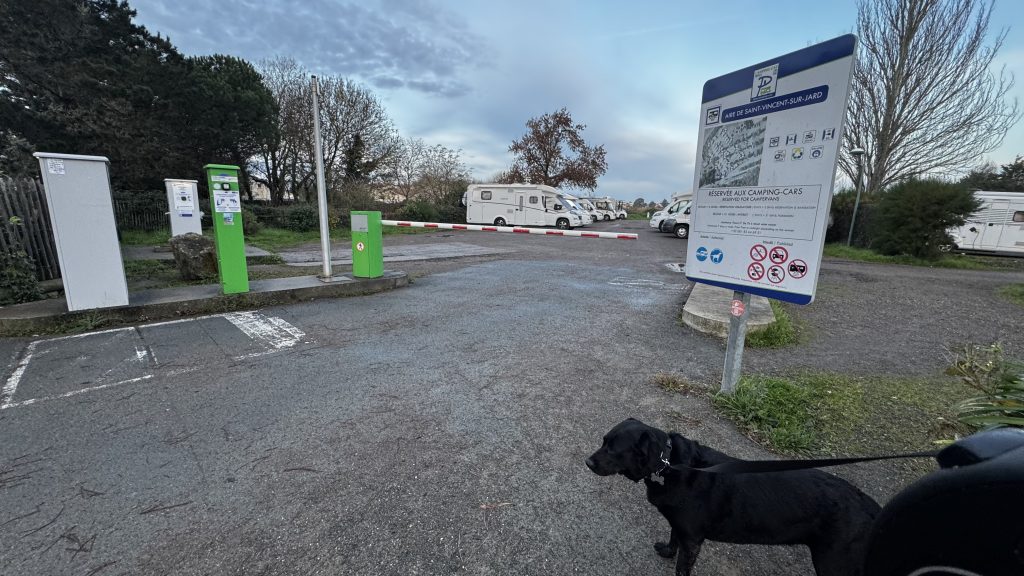
Aires are brilliant: cheap, simple, scattered across the continent like welcome mats. But their electrical feeds? Our experience so far, wildly inconsistent.
Some are rock-solid.
Some are “6 amps” – just.
Some trip if you look at them sideways.
A few have their live and neutral swapped (reverse polarity, always a treat).
And the occasional one, like in our recent experience, can deliver a nice little voltage spike just to keep life interesting.
In our case the spike took out power at the bollard, and because we were literally about to leave, we thought nothing more of it. Inconvenient timing — the next aire didn’t have electricity, so we simply switched over to the EcoFlow Delta Pro to run our 230V. No fuss, no impact.
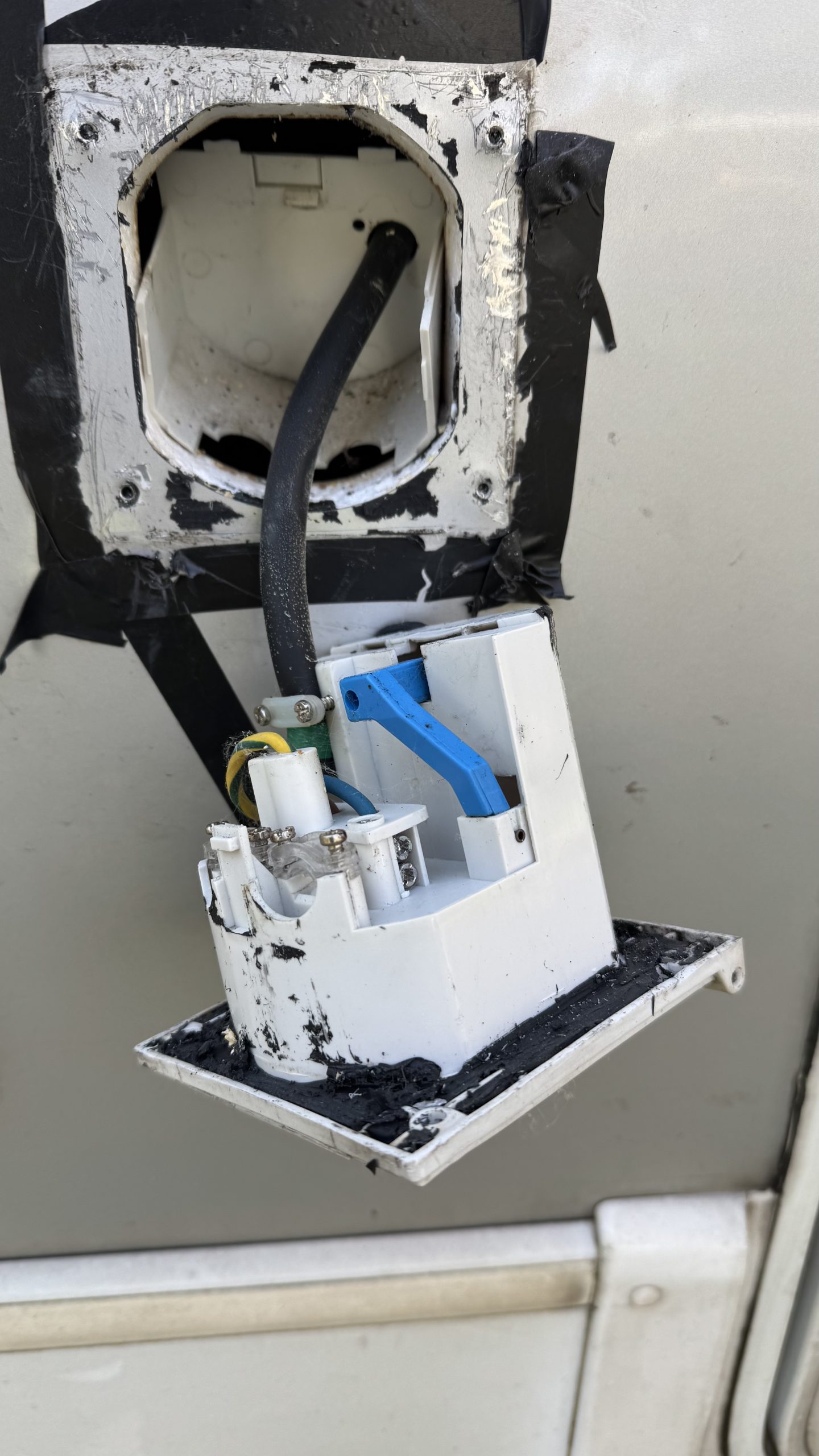
Fast-forward three days. New aire, shore power available, cable plugged in… nothing. Dead. That’s when we discovered the spike hadn’t stopped at the bollard; it had knocked out the motorhome’s 230V gear as well. The 12V side was fine — lights, pumps, heating controls all normal — but the van simply wouldn’t accept mains when we plugged the cable into the socket at the side.
The workaround proved to be easy enough: power the motorhome from our EcoFlow power station instead. But until we repaired the damaged inlet equipment it meant running the cable through the driver’s window.
Not ideal, but it worked — and it proved the value of having a properly separated system and a reliable auxiliary. The van kept running, the trip didn’t miss a beat, and we learned a thing or two about the realities of aire electrics along the way..Still, it underlines the reality:
Aire electricity isn’t a domestic wall socket. You’re plugging into whatever infrastructure is there… and whatever condition it’s in.
2. The culprit: Overloading without meaning to
Most of us don’t set out to overload a supply. It’s usually innocent.
On a 6A supply, a 700–900W appliance can tip you straight into trip-out territory. Add in a minor voltage wobble and you suddenly have a perfect storm.
In our case it was an oversight. We were moving to an aire with no electricity for two days, so we were making sure the power stations were fully charged. Without thinking, we also used the coffee machine, the demand too great and the spike tripped the supply.
3. The Unsung heroes: Split 230V and 12V systems
The good news? Our design choice to separate the 12V and 230V systems did exactly what we wanted them to do when something goes wrong: it is designed to keep the essential functions running.
When the 230V input collapsed, the 12V system didn’t even blink. Lights, pumps, heating control, fans — all fine.
No sense of “emergency mode,” just calm continuity.
Two independent systems mean one can falter while the other carries on, which in a motorhome feels reassuringly like redundancy done right.
4. The auxiliary ace: EcoFlow + smart switching
The real star of the episode was the auxiliary power station setup. Once the mains died, the EcoFlow Delta Pro took over through the Dometic SP230 smart switch we installed.
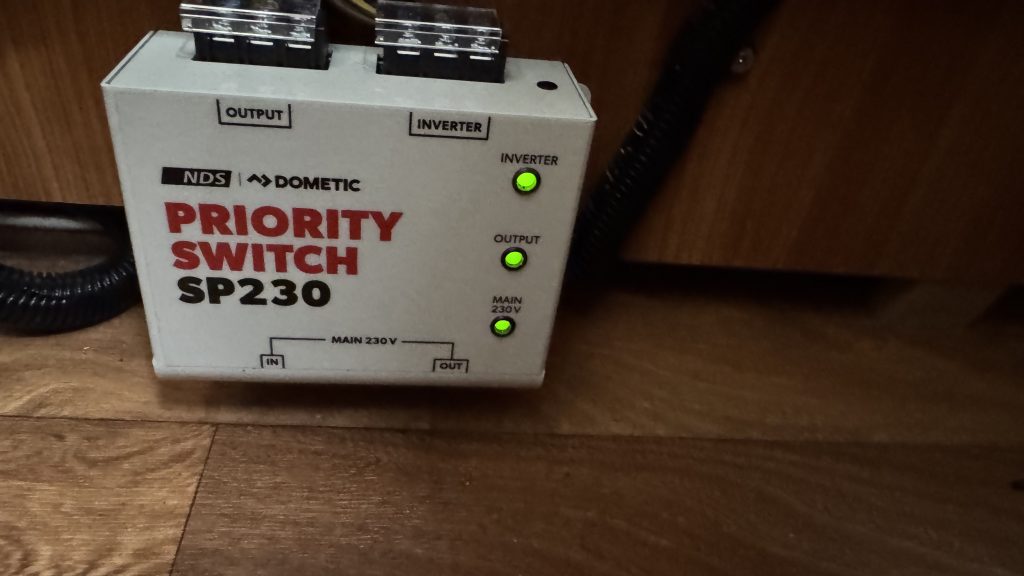
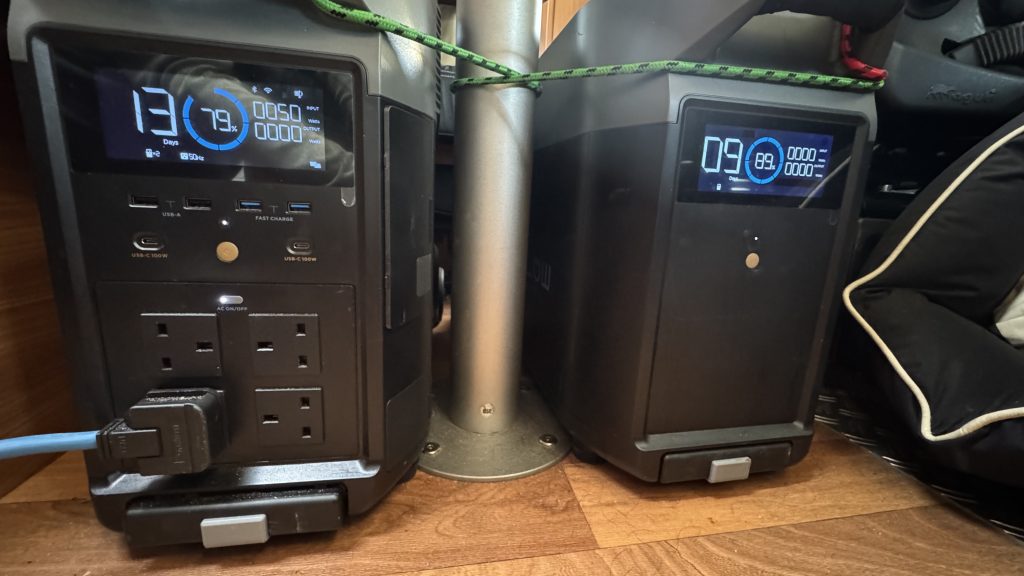
This three-part combination worked exactly as intended:
230V in → SP230 protection → Smart switch → Motorhome
And when the 230V went bad, the backup slid into place without fuss.
A few wins here:
• Backup with brains
It’s not just a battery. It’s a stable inverted AC supply that won’t spike, sag, or stutter.
• Safe handover
With the smart switch doing the thinking, there’s no manual toggling or risk of cross-feeding.
• Independence from campsite gremlins
If the aire trips, shrugs, or fizzles, you don’t lose your evening or your temper.
Everything vital keeps running, and you get time to diagnose the issue on your terms.
5. Reverse polarity: It pays to check
We were three weeks into France before we met our first reverse-polarity bollard. Reverse polarity simply means the live and neutral are swapped — not dangerous in itself, but not ideal. It’s also far more common on the continent than you’d think.
I’d heard about it before we left the UK and bought a socket tester and a polarity-reversing adapter. Honestly, I assumed they’d just sit in a drawer. The test is straightforward: before plugging in the shore cable, I plug in the tester. Three lights = normal. One light = reversed.
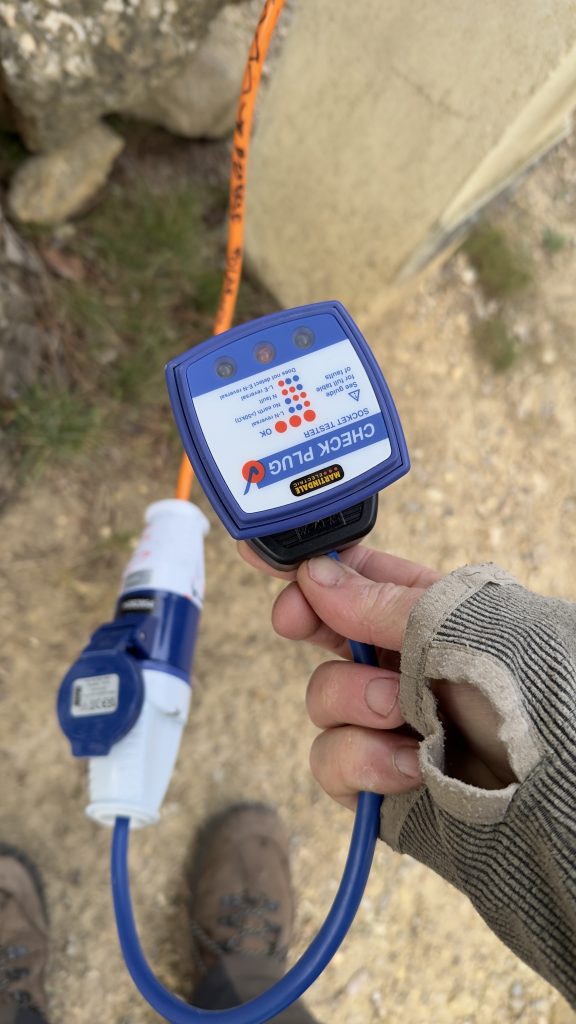
Moissac was the first time I saw that lonely single light. A slight jolt of “oh… it does happen.” Fortunately, the second socket on the bollard tested fine, so I used that.
The following day, we reached our next stop — a campsite this time — and got the same one-light reading again. No spare socket, so out came the adapter. Plugged in, tested again, all lights normal.
Most modern motorhome kit will tolerate reverse polarity, but that’s not really the point. You don’t know what the bollard ‘s history is, how tidy the wiring is behind the scenes, or what else has been done “creatively” along the way. It’s simply better to check, and better still to correct it when you can.
6. The Takeaway: It’s not about fear — It’s about preparedness
This isn’t a story about disaster. It’s a story about a system behaving admirably under stress.
The spike highlighted three solid principles worth sharing:
- Aire electricity is a convenience, not a guarantee.
- Split 230V/12V systems give us robustness when it mattered.
- A well-designed auxiliary supply turns a failure into a non-event.
If anything, the experience reinforced why we’d invested time and effort into the electrical architecture. The van didn’t “survive” a spike — it shrugged it off.
In a moving home where the weather changes, supplies vary, and infrastructure is unpredictable, that’s the kind of system behaviour that earns its place.