

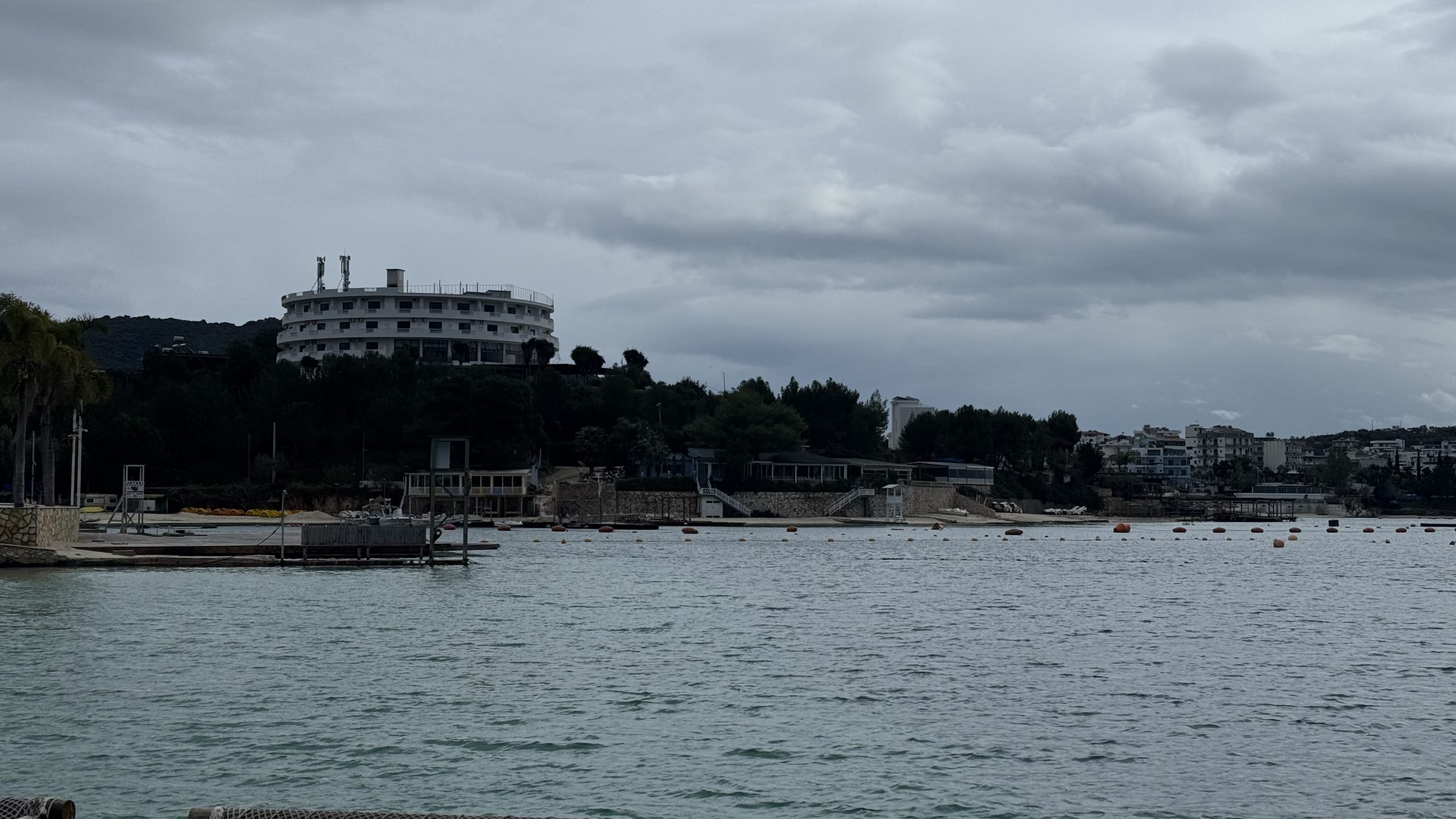
Each morning we exchange the same two words.
I say good morning in Albanian.
She replies.
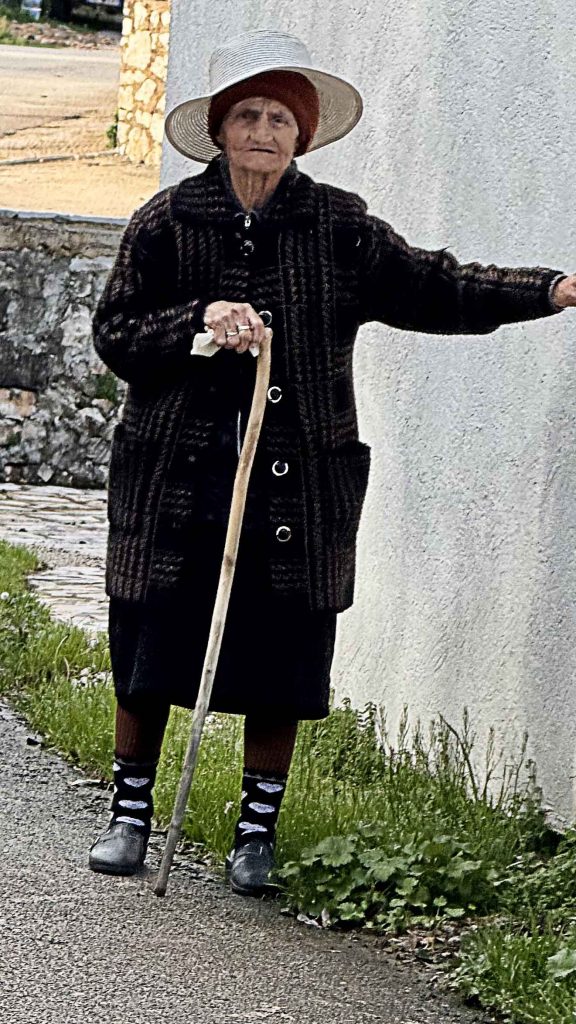
She stands or sits just inside her gate, positioned where the sun reaches first. She is likely in her late seventies; a walking stick rests lightly in one hand, not leaned on so much as included. We have never spoken beyond that greeting and after a while it becomes clear that conversation would add very little. The routine already contains enough information.
At first she seemed to be the subject — a familiar figure marking the start of our daily walk. Gradually the relationship reversed. She stayed constant and the street began to explain itself.
This part of Albania looks newly assembled, but most of its history has occurred within a single lifetime.
1950s — The village as boundary
She was probably born just after the Second World War, when the new communist state sealed the country almost completely from the outside world. Travel stopped, private trade stopped, religion was discouraged and then banned. The future became a national project rather than a personal one.
The sea at the end of the road was not scenery. It was a limit.
You did not look across it and imagine going anywhere.
Fishing boats worked close to shore. Families grew what they could. Electricity was uncertain. The idea of a visitor from another country belonged to stories rather than possibility. The village faced inward because the country did.
1960s — The organised life
Isolation deepened as Albania broke with its allies one by one. Work, schooling and youth activities were structured through the state. Stability replaced choice; predictability replaced ambition.
Summers still meant time on the beach, but not leisure in the modern sense — more a continuation of daily life outdoors. The coast did not belong to tourism. It belonged to living beside water.
Nothing was being prepared for a different future because no different future was expected.
T970s — Permanence
This was the era when the system felt permanent.
Employment assigned, housing allocated, prices fixed. Domestic holiday camps existed, but foreigners did not. The coastline functioned as shared national space rather than economic resource. The horizon remained geographical, not aspirational.
If you stood where she stands now, you would not have been observing change — only confirming repetition.
Assigned Lives
A man we met here, now 57, once wanted to become a dentist. instead, the Communist Party assigned him to teach science and mathematics.
He completed four years of university study for a profession chosen for him rather than by him.
Motivation, in such a system, did not come from aspiration but obligation — and from learning to inhabit the life provided.
Personal ambition was secondary to national need. Careers were not discovered; they were distributed.
1980s — First awareness
Television introduced fragments of elsewhere. Not travel, just awareness. The outside world became imaginable but still unreachable.
Repairs replaced renovations. Maintenance replaced development. Time passed seasonally rather than historically.
The sea still meant food, weather and orientation. Nothing yet suggested it would become something to look at rather than live from.
1990s — Opening
The system ended quickly. Borders opened. People left almost immediately, many crossing waters they had spent their lives not crossing.
Money returned before experience did — remittances from Greece and Italy transforming houses room by room. Shops appeared. Ownership appeared. So did uncertainty.
In 1997, the collapse of nationwide pyramid investment schemes briefly removed central authority altogether. Daily life contracted back to neighbours and routine.
For the first time, the village possessed a future that could not be predicted.
2000s — Freedom without rules
What followed felt less like transition and more like improvisation.
Locals describe the coastline during the late 1990s and early 2000s as resembling the American Wild West. Families claimed pieces of empty shoreline and began building houses wherever they could. Ownership existed in practice before it existed in law.
In 2007 the government captured satellite imagery of the coastline to establish a legal reference point for land ownership.
The Satellite Line (2009)
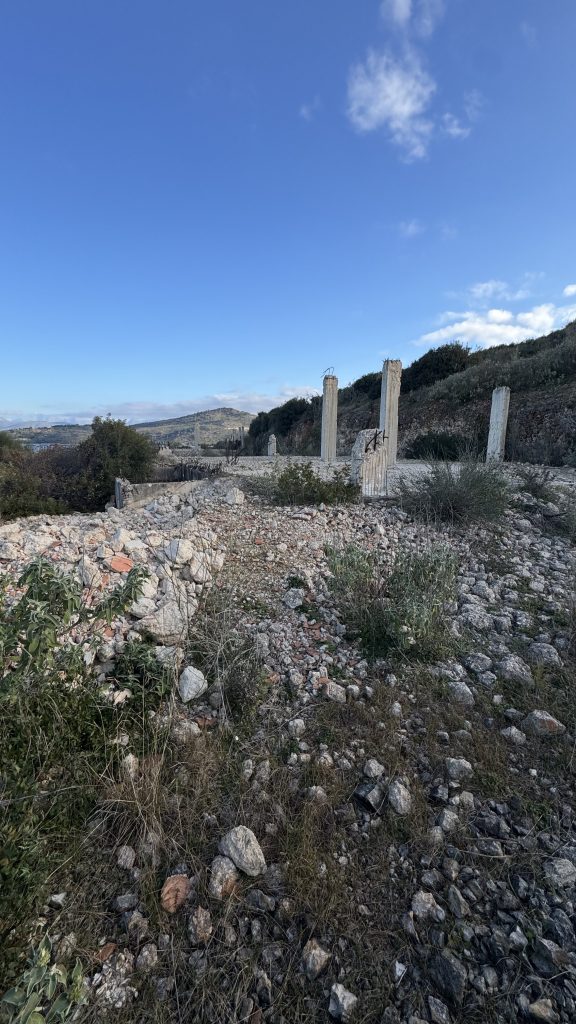
Two years later, in March 2009, bulldozers arrived. Officials and police moved along the coast demolishing every structure not visible in that earlier photograph — buildings half-finished, newly occupied homes, speculative constructions.
Some were only partially destroyed. Others were abandoned and later stripped for materials. The broken shells remain scattered along the shoreline today: physical evidence of a country attempting to impose order after sudden freedom.
For many residents, modern Albania did not arrive gradually. It arrived in a single morning.
Concrete rose quickly. Planning followed later — if at all.
The coast shifted from livelihood toward opportunity, but without shared agreement on what opportunity meant.
2010s — Reorientation
Tourism began to stabilise the chaos. Cafés appeared. Languages mixed. Summer developed a different rhythm from winter.
The sea became backdrop as much as resource.
The village learned presentation — not entirely comfortably — as daily life continued inside spaces increasingly designed for visitors. The same water now meant relaxation to some, income to others.
2020s — Acceleration
Today the street feels temporarily unfinished. Walls opened, buildings stripped, terraces added, wiring exposed in preparation for something not yet settled.
The atmosphere resembles a house mid-renovation: intention everywhere, completion pending.
Change is no longer seasonal but continuous.
What once evolved slowly now sometimes feels revolutionary — not because the culture changed suddenly, but because time itself sped up.
The Constant
Each morning the greeting remains identical.
She occupies a fixed point while meanings rotate around it — boundary, livelihood, escape, speculation, tourism — all attached to the same stretch of coast within one lifetime.
For us the place is new and changing quickly.
For her it may simply be the latest normal.
Travel often encourages comparison between countries. Standing in this street suggests a different comparison: between speeds of time. Our lives measure change by relocation. Places like this measure it by reinterpretation.
Tomorrow the sun will reach the gateway again. We will exchange the same two words, and the village will continue becoming something that did not previously need to exist.

Interesting reflection and perspective.