

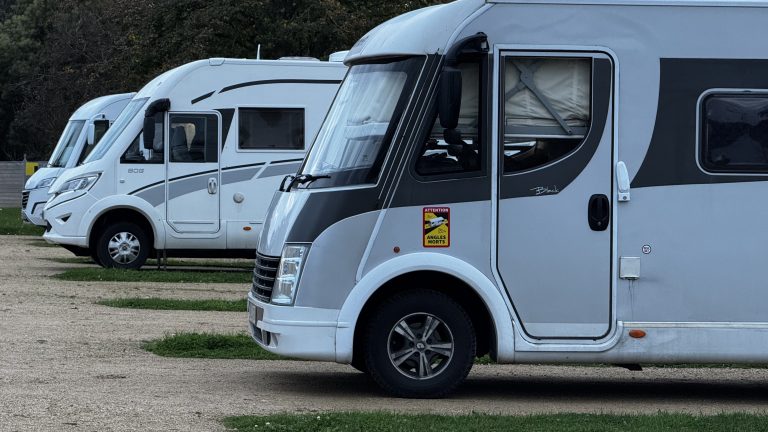
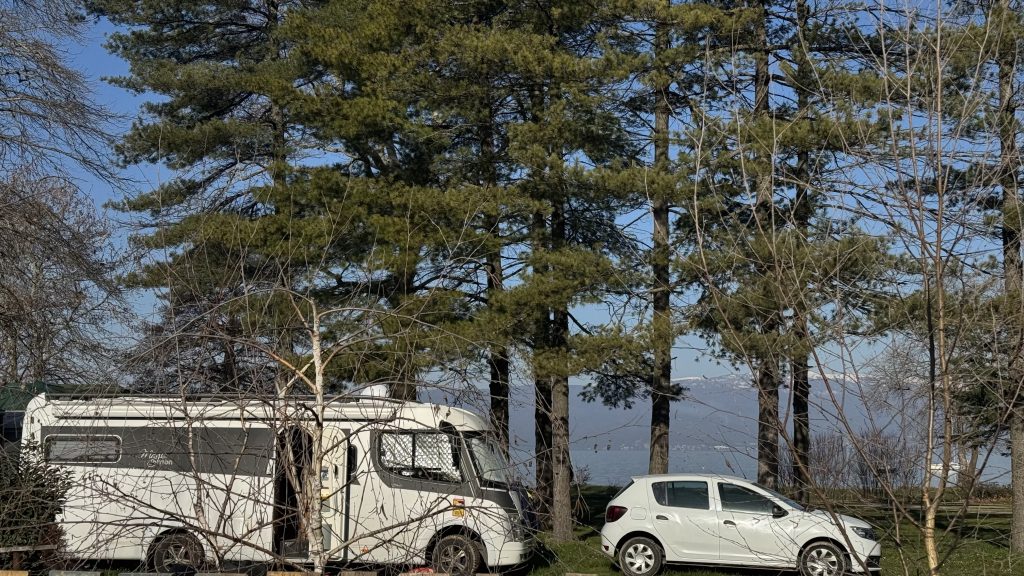
For most of our time at the campsite above Lake Ohrid we have been almost alone. A handful of vans scattered across the terraces. Long stretches of quiet. The lake stretching out below us in that deep, improbable blue. And yet, every so often, another traveller appears.
A Canadian couple one evening. An American pair a day later. A Dutch family with small children. This morning a British-registered van arrived, though it turned out he was Irish and she Bulgarian — which felt somehow appropriate given where we are.
Each time the same small ritual unfolded. A brief exchange across the gravel. A few minutes of conversation. And the questions are always identical. “Where have you come from?”
“Where are you heading next?” Within ten minutes you know a surprising amount about people you met only moments ago. Within a day or two they are gone again.
This is the quiet rhythm of life on the road. Even when campsites are sparse, a social pattern emerges almost automatically. Strangers recognise one another, exchange information, and briefly become neighbours before moving on. From a distance it might look like nothing more than a few vehicles parked on a hillside. From inside it begins to resemble something else entirely — a very small, very temporary village.
When the map changes
The popular image of motorhome travel is retirement: silver-haired couples circling Europe after a lifetime of work. That happens, certainly. But spend time on the road and you notice something else. Most people arrive here when the map of their life has quietly shifted in some way.
Some are retirees who have looked at the script of conventional retirement and decided it resembles waiting for old age to descend upon them. The motorhome becomes a machine for active ageing. If they are navigating roads, fixing small problems, and discovering places, they remain participants rather than spectators. Others are young families who have stepped off the conveyor belt of early schooling. Their children learn geography by standing in it and history by climbing over it.
You also meet a surprising number of solo travellers whose lives have recently fractured. Divorce appears often in road stories. A house can become a museum of a previous life; a van offers a clean slate. Every cupboard, every route, every decision belongs to you again.
And increasingly there are remote workers who have realised that if their office is a laptop, there is no reason it needs to sit in the same building every day.
Different starting points. Yet they all end up here, sitting outside a vehicle that contains everything they currently own, watching the evening light fall across somewhere they had never heard of a week earlier.
The hierarchy of the highway
Despite the relaxed rhetoric of “one big travelling family”, the road has its own quiet hierarchy.
It is not purely about money. What really separates people is how they live inside the vehicle.
Most motorhomes — A-Class or coach built — are built around fixed interiors. Beds remain beds. The kitchen stays where it is. The bathroom sits permanently behind its door. Perhaps a bed lowers over the cab, but fundamentally the architecture stays constant. Living inside feels like occupying a small apartment that happens to move.
Camper vans work differently. Their interiors are modular worlds that shift throughout the day. The driving position becomes a lounge. The lounge becomes a bedroom. Tables appear and disappear. Seats rotate, fold, slide and transform. Some travellers love this daily choreography. Others find it faintly discombobulating. It isn’t really about luxury or austerity. It’s about temperament. Some people want a moving apartment. Others enjoy the small puzzle of making space change shape around them.
Independence rather than luxury
Large motorhomes are often assumed to exist mainly for touring between comfortable campsites. Many owners would argue the opposite. Modern motorhomes carry large water tanks, significant battery storage and enough solar generation to run a small household. Proper bathrooms and kitchens mean the vehicle functions as a completely self-contained system. For many travellers the real pleasure lies in not needing infrastructure.
Even when staying on campsites we tend to use our own shower, our own loo and wash our pots in our own sink. Not from stubbornness — simply because the vehicle is designed to do these things perfectly well. There is a quiet satisfaction in knowing the whole system works.
The brand tribes
Alongside this practical hierarchy sits another, more tribal one: the brands.
Volkswagen occupies a category entirely of its own. The VW camper long ago escaped the category of vehicle and became something closer to a cultural movement. When two pass each other on a quiet road the wave is immediate and enthusiastic.
Hymer carries its own reputation, spoken of with the calm confidence usually reserved for well-engineered tools.
At the upper end sit the grand liners — Morelo, Concorde, Frankia, Carthago — machines that glide into campsites with the quiet authority of small touring coaches.
And then there is the newest tribe.
The expedition machines
Every so often something enormous appears at the edge of a campsite. A truck-based vehicle built on a MAN or Mercedes Unimog chassis, sometimes four-wheel drive, sometimes six. Spare tyres the size of dining tables. Fuel and water tanks suggesting serious ambition. These are expedition vehicles. They are built not for campsites but for continents. Their owners talk casually about Central Asia, desert crossings or the long road through Patagonia.
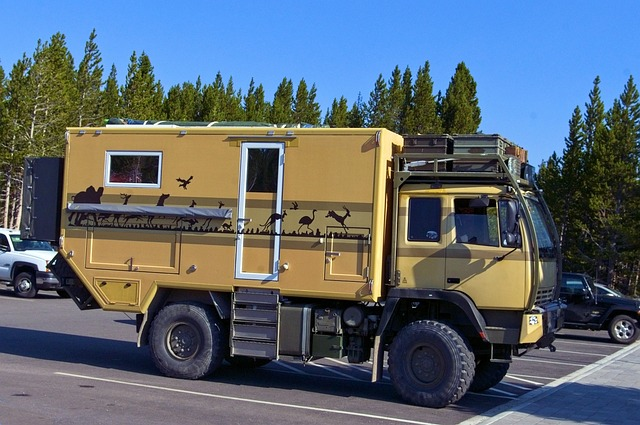
Among ordinary motorhome travellers they inspire both admiration and gentle scepticism. Some see them as the ultimate expression of freedom. Others quietly suspect they spend rather more time beside European lakes than crossing Mongolia. Like every tribe on the road, they have their followers and their critics.
The rituals of recognition
Transient societies develop rituals quickly. Motorhome culture has several. The first is the wave.
Two vehicles pass on a quiet road and a hand lifts from the steering wheel. It is a small gesture but a meaningful one: I see you. You’re doing this too. The wave has variations. A relaxed two-finger lift is the casual version. A full hand raised enthusiastically usually means identical vehicles have recognised one another. Failing to return the gesture can feel oddly like a small social breach.
Then there is the theatre of arrival. When a new van pulls into a campsite, neighbours subtly adjust their chairs to watch the parking manoeuvre. It is partly helpfulness, partly spectator sport. There is a delicate etiquette here. Offer help too early and you insult the driver’s competence. Offer it too late and you appear unhelpful. Eventually the handbrake goes on and the performance ends.
Home as a verb
One of the stranger discoveries of life on the road is that home stops being a place and becomes something you do. A small rug appears beside the van door. Chairs unfold. A lantern or string of lights marks the edge of a temporary territory. Twenty square feet of gravel becomes a living room.
These small gestures transform a parking space into something recognisably domestic. They also mark boundaries. Step onto someone’s rug uninvited and you have effectively walked into their house. Even nomads draw invisible fences.
Dogs know something we don’t
If anything cuts across the subtle hierarchies of the road, it is dogs.
A couple in a £200,000 motorhome and someone in a battered van may never exchange a word — until their dogs start playing together. Within minutes everyone is talking. Dogs bypass the quiet snobbery of vehicle types and introduce people who might otherwise remain strangers. They also do something else.
In a life defined by movement, the dog becomes the one constant presence. Morning walks, evening walks, familiar routines that anchor the day. For the dog the question of where home is never really arises. Home is wherever the pack stops.
Villages that last a night
From above, a campsite looks like little more than parked vehicles. From inside it becomes something else entirely. A temporary village appears — complete with etiquette, rituals, quiet hierarchies and the occasional shared bottle of wine.
Stories circulate. Advice is exchanged. Someone mentions a reliable mechanic two valleys away.
Then the engines start. Chairs fold away. Dogs climb back inside. The village dissolves. A few hours later it will quietly reassemble somewhere else on the map.
Standing beside Lake Ohrid — a lake that has existed for more than a million years — the contrast is hard to ignore. The lake endures through geological time. Our small travelling villages last a night or two. And yet, for the moment they exist, they feel every bit as real.
Perhaps that is the deeper secret of the road. Human beings do not need much geography to create a society. Just a patch of ground, a few shared rituals, and the quiet understanding that — for tonight at least — we are neighbours.