
News from the road
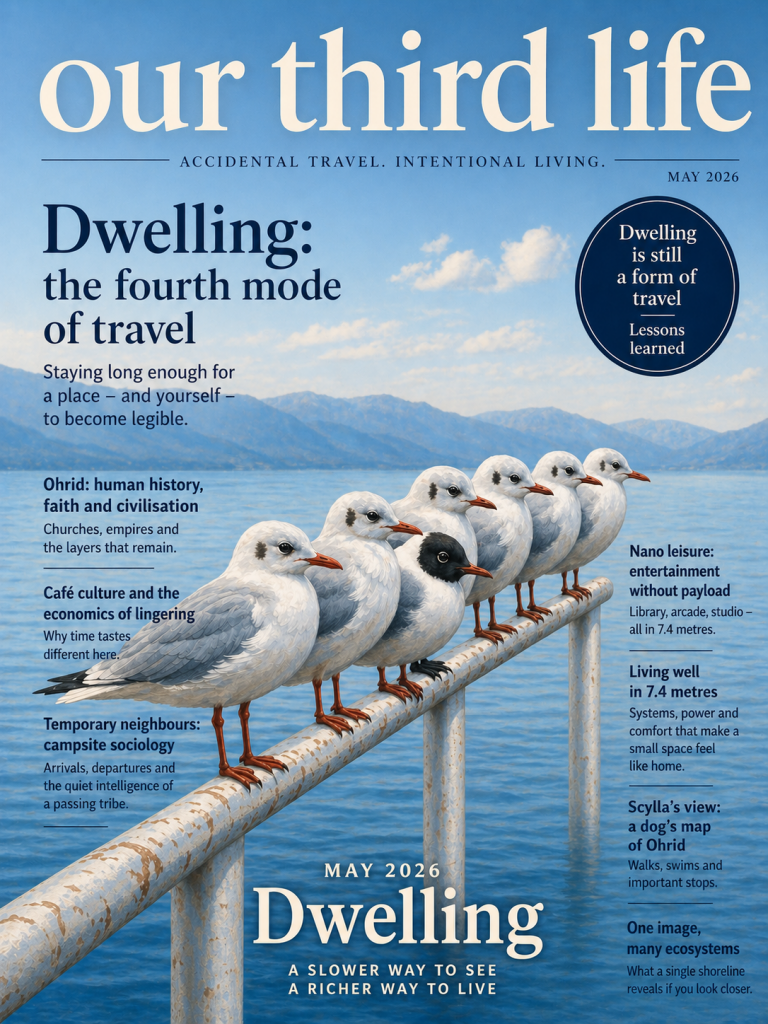
Travellers like to believe they choose their destinations. Sometimes a place chooses you. Ohrid did that to us. When we arrived beside the lake the plan was simple enough: a short stop before continuing the journey. Two or three days perhaps — long enough to stretch our legs before moving on again.
We knew almost nothing about the place. We did not yet know the city, the lakeside promenade, or even which way to walk out of the campsite — left or right. The site itself sits on a rustic road beside the construction of a new hotel, with a spoil dump and waste ground opposite. Hardly the sort of setting that suggests lingering. And yet we stayed.
At first the decision felt temporary. Another night, then another. Gradually the rhythm of movement gave way to something calmer. Without any formal decision being made, travelling paused and something closer to living quietly took its place.
It was not only us who felt it. A Welsh couple we met here — travellers who rarely remain anywhere for more than two days — found themselves staying for five. Another pair visiting for a weekend spoke openly of their envy when they learned we intended to remain longer. They wished they could do the same.
Something about Ohrid encourages lingering. Perhaps it is the lake itself, which shifts subtly in colour and mood throughout the day. Perhaps it is the scale of the town, large enough to feel alive yet small enough for its rhythms to become familiar. Or perhaps it is simply the way daily life unfolds here, without any constant pressure to hurry. Whatever the reason, slowing down changes how a place reveals itself.
Travelling rewards movement. The satisfaction often comes from covering ground and discovering what lies around the next bend. Yet remain somewhere a little longer and a different experience begins to emerge. Patterns appear.
You notice the quiet communities that form among travellers themselves, temporary settlements appearing and dissolving as vehicles arrive and leave. You see how cafés function not simply as places to drink coffee but as steady centres of daily life. Even routine walks begin to reveal a landscape of familiarity — for us, and very clearly for Scylla.
None of these things stand out during a brief visit. They reveal themselves slowly. The longer you remain, the more a place begins to explain itself. That realisation shaped this month’s articles. What began as a pause in the journey became an opportunity to observe the small structures of life around us — the rhythms of the town, the social spaces people gather in, and the temporary communities that appear wherever travellers settle for a while.
Ohrid, it seems, is one of those places that rewards attention. Travelling introduces you to landscapes. Dwelling, even briefly, allows you to see how life moves through them.
For now, at least, we have stopped long enough to notice.
Inside this issue
Feature
Dwelling – When travelling pauses
What happens when movement slows and dwelling takes over. The travel may pause, but the Third Life journey continues.
History & culture
Ohrid: The human landscape Part two of two
Spend a little time in Ohrid and the layers of history begin to show. This second article explores the human story and cultural influence that shaped the region.
Nomad life
How a campsite becomes a village
An observational look at how temporary communities form wherever travellers stay for a while.
Scylla’s view
The lake route
What a lakeside world looks like when experienced through scent, sensation and sticks.
Food & drink
Cafe culture: The rhythm of time
Stay long enough in Ohrid and the cafés reveal something deeper about how time is lived here.
Systems & technology
A house that moves: How we live permanently in 7.4 metres
When you dwell somewhere, the emphasis shifts from vehicle to home. A look at daily life inside a small but complete living space.
Living in the van
The smallest room in the home
One small locker holds the equivalent of an entire games room, thanks to digitisation — a surprising advantage when living on the road.
Forensic photo (new column)
A new regular feature that slows photography down. Each edition we dissect a single image to explore what it explicitly shows, what careful observation reveals beyond the frame, and what the wider landscape quietly tells us if we take time to look properly.
This month: Spring arrives in shifts
One photograph of Lake Ohrid reveals retreating snowlines, hidden wildlife, changing weather and the surprising ecological richness of an unglamorous spoil heap.
Lessons learned
April reflections
What staying still for a while can teach you about travel, place and attention.